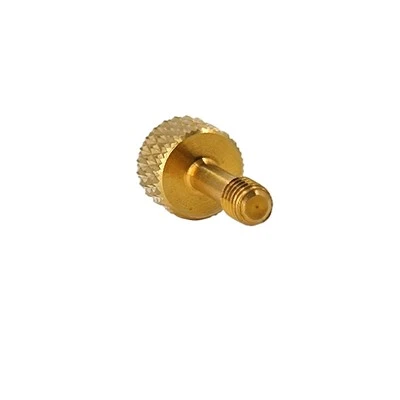
A brass knurled step flange rivet is a specially designed rivet that combines multiple structural and functional characteristics. It is a fastener commonly used in electronic equipment, hardware accessories, and the decoration field. Its characteristics and usage methods are covered as follows.
1. Product Introduction
Material: Brass, corrosion-resistant, and good conductivity.
Structure: The head has a knurled texture to prevent slipping, the step design provides a limiting effect, and the flange edge increases the contact surface.
Application: Suitable for occasions that require beauty, anti-loosening, and conductivity, such as circuit board fixing, panel assembly, etc.

2. Usage steps
Preparation
Tools: Riveting gun/manual rivet pliers, matching rivet core rod.
Check: Confirm that the rivet diameter matches the mounting hole.
Installation process
1. Insert the rivet: Place the rivet in the pre-drilled hole, the flange surface is close to the surface of the workpiece, and the step part is inserted into the hole. The knurled side faces outward (anti-slip or beautiful side is required).
2. Riveting fixation: Clamp the tail of the rivet with a riveting tool, pull the handle at a constant speed until the core rod breaks, and the tail of the rivet expands and clamps the workpiece.
Key point: Keep the rivet perpendicular to the workpiece to avoid skewing. Brass is soft, so the force must be even to prevent the head from deforming.

3. Check the effect
Confirm that the flange surface fits seamlessly, the rivet is not loose, and the knurled part is not damaged.
III. Precautions
Material adaptation: Avoid direct contact with aluminum, as it may cause electrochemical corrosion.
Reusable: Rivets are disposable fasteners and need to be replaced with new parts after disassembly.
Special environment: It is recommended to apply antioxidants in humid environments.
IV. Common problem handling
1. Loose rivets
Reason: The aperture is too large or the riveting force is insufficient.
Solution: Replace with a small-diameter rivet or re-rivet.

2. Wear of the head knurling
Reason: The tool is clamped too tightly or the material does not meet the standard.
Solution: Use a riveting tool with a rubber pad.
Brass knurled step flange rivets are easy to operate, but attention should be paid to type selection, vertical riveting, and force control. Suitable for scenarios with requirements for anti-slip and conductivity, the correct use can ensure long-term stability.
This solution takes into account both manufacturing feasibility and application reliability, and the parameter weights can be adjusted according to specific working conditions. It is recommended to provide a sample trial installation to verify adaptability.
This design achieves a balance between functionality, reliability, and process cost through the coordinated optimization of materials and structures, and is suitable for the precision assembly needs of small and medium-sized equipment.