Installation of Brass Insert for plastic
Hot Melt Nuts:
Hot melt embedding is the most common and standard insertion method. It is typically done using a hot melt machine or a manual electric soldering iron to embed the nut.
Injection Molding Nuts:
Injection molding requires strict control over the hole size of the nut, generally within 0.05 mm. This is because the nut is fixed by a molding pin and placed into the injection molding machine. The nut hole size is controlled by the size of the molding pin.
Ultrasonic Nuts:
Ultrasonic embedding is a process that uses ultrasonic vibrations to create friction between the nut and the surface or internal molecules of the workpiece. This friction raises the temperature at the interface. When the temperature reaches the material's softening point, the nut is embedded into the plastic part. After the vibration stops, the workpiece cools and solidifies under pressure.
Plastic Hole Design and Nut Selection Parameters
d dimension (Nut Base):
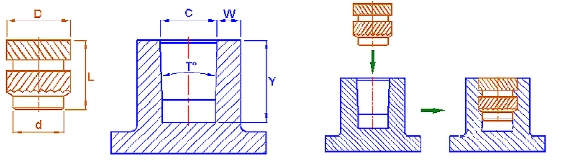
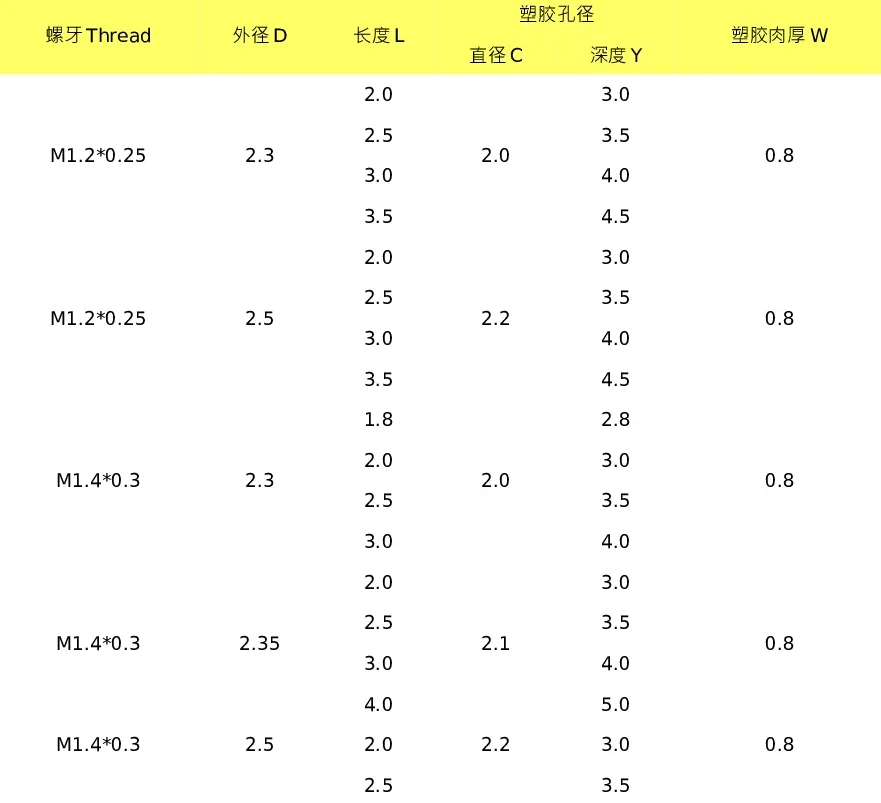
The d dimension is the nut base, also referred to as the guiding and positioning part. Before embedding, it fits into the plastic part, so the d dimension must be smaller than the internal diameter of the plastic BOSS hole (C) to facilitate proper positioning.
D dimension (Nut Outer Diameter):
The D dimension is the nut's outer diameter, which must match the internal diameter of the plastic BOSS hole (C). Typically, the internal diameter of the plastic BOSS hole is about 0.25-0.3mm smaller than the nut's outer diameter.
L dimension (Nut Length):
L represents the nut length, which must fit the depth of the plastic BOSS hole (Y). Generally, the depth of the plastic hole is 0.5-1.0mm larger than the nut's length to allow for plastic storage.
W dimension (plastic hole wall thickness):
The W dimension is the thickness of the plastic hole wall. The thickness of the plastic BOSS hole wall is typically 0.8-1.0mm or more. The larger the nut, the thicker the plastic wall will need to be.
Impact of Plastic BOSS Hole Size on the Nut Insertion
|
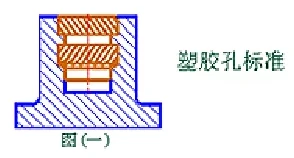
Ideal Insertion:When the nut and plastic sizes are properly chosen, the nut embeds perfectly into the plastic.
|
|
|
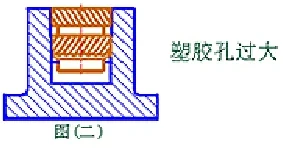
Overly Large Hole (Figure 2): If the nut is too small and the plastic BOSS hole is too large, the nut will not engage properly with the plastic, resulting in insufficient torsional strength. |
|
|
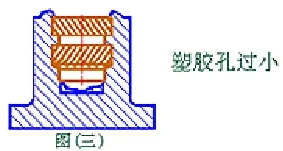
Overly Small Hole (Figure 3): If the nut is too large and the BOSS hole is too small, it may cause plastic overflow or cracking. |
|
If both the nut and plastic sizes are correct, but abnormal issues still occur, optimization designs can be considered.
Example 1: Insufficient Torsional Strength Due to Shallow BOSS Hole Depth
If the BOSS hole depth is too shallow, selecting a double-slotted nut may cause insufficient plastic engagement in the nut's slot, leading to low torsional strength. In such cases, it is recommended to set the BOSS hole depth to 2.5 mm or more, and the nut length should generally be 2.0 mm or more. If mold modification is not possible, switching to a single-slotted nut with a larger slot length (BS1) can help improve engagement and increase torsional strength.

Example 2: Plastic Overflow and Cracking of the BOSS Hole
If the nut style shown in the left image is used, the nut will expand at the A1 and A2 parts during embedding, while the B part contracts sharply, making it difficult for the plastic to flow. This may lead to plastic overflow or cracking. To avoid this, a guide part (C) can be added to help position the nut accurately within the plastic hole, improving efficiency and yield. The design of the nut, with a 90° and 45° angled groove, forms high-strength nodes that resist torsional forces, greatly increasing the torsional strength.