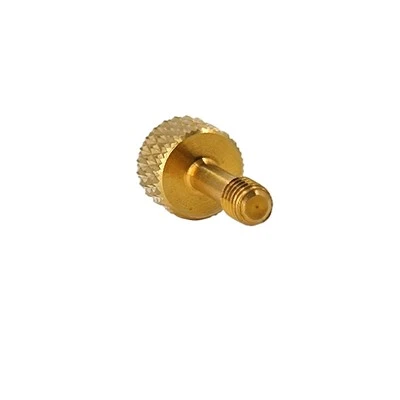
Methods of Embedding Brass Nuts into Plastic Parts
Brass nuts can be embedded into plastic parts using various methods, including mold-insertion during molding, hot pressing, ultrasonic insertion, and cold pressing. Among these, hot-melt embedding is the most common and widely used method, typically performed with a hot-melt machine or a manual electric soldering iron.
In hot-melt embedding, the brass nut is heated to a certain temperature, softening the plastic, and then pressed in. This method generates relatively low internal stress while providing excellent pull-out and torque resistance.
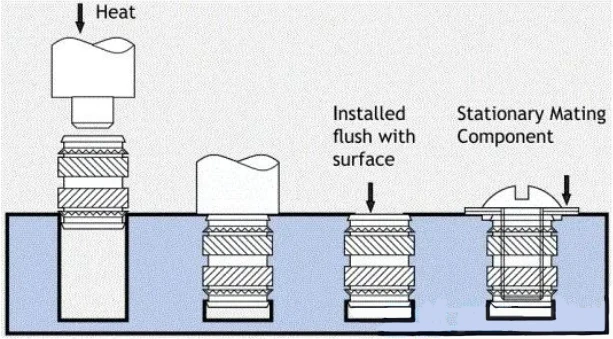
Hot-Melt Nut Insertion Machine - Working Principle
The machine uses an electric heating fusion principle, accurately controlling temperature changes in combination with mechanical devices to achieve embedding. It is especially suitable for products that are difficult to weld, irregular in shape, or relatively large in size.
It is used for plastic welding, nut embedding, riveting, and similar applications.
Hot-Melt Nut Insertion Process
Vibration Feeding
The operator only needs to load the required number of brass nuts into the vibrating feeder at the start of each shift. The system automatically arranges the disordered nuts into an orderly sequence. Maximum feeding speed can reach 200 pieces/minute.
Heating and Feeding
Nuts exit the vibrating feeder and slide into a high-temperature tube (with adjustable temperature settings). After preheating in the heating zone, they are fed into the machine head, ready for insertion.
Embedding
The preheated nuts are pressed into the plastic housing by the machine head. The insertion temperature can be adjusted, and a positioning limiter is applied.
Movement
X, Y, and Z axes are driven and precisely positioned via programmed control.
Key Control Parameters:

Hot-press head temperature
Preheating time
Embedding time
Matching Plastic Holes with Nuts
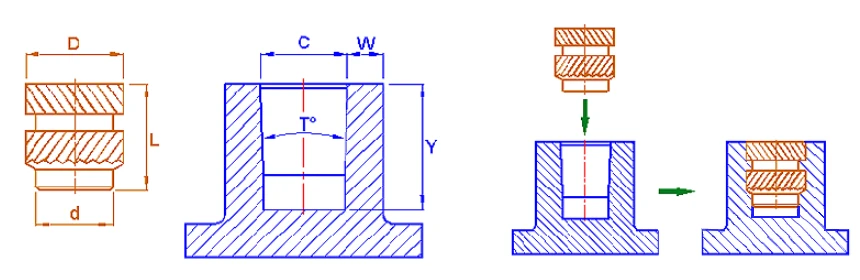
D: Nut outer diameter
L: Nut length
d: Nut base diameter
C: Plastic hole diameter
W: Plastic hole wall thickness
Y: Plastic hole depth
The d dimension (nut base) - also called the guide positioning section - fits with the C section (plastic hole) before embedding. The nut's bottom d part should be slightly smaller than the plastic boss's inner hole diameter C to allow for positioning.
The D dimension (nut outer diameter) matches the C dimension (plastic hole diameter). For example, in mobile phone nuts, the plastic inner hole diameter is generally 0.25–0.3 mm smaller than the nut outer diameter.
The L dimension (nut length) matches the Y dimension (plastic hole depth). Typically, the hole depth is 0.5–1.0 mm deeper than the nut length to provide a resin reservoir.
W (wall thickness) should generally be 0.8–1.0 mm or more. The larger the nut size, the greater the required wall thickness.
Advantages and Applications of Hot-Melt Nuts
Advantages:
Easy assembly and disassembly
High pull-out and torque resistance
Reusable threads with strong locking performance
Lower operator skill requirements, reliable fastening
Space-saving in length design
Simplified hole design
Suitable for certain high-temperature conditions
Applications:
Hot-melt brass nuts are widely used in electronics, hardware, plastics, lighting, toys, sanitary ware, furniture, medical devices, and sports equipment.
Examples include:
Laptop plastic housings
GPS device housings
Router housings
Mobile phone housings
Wireless communication device housings
Home appliance plastic housings
Automotive parts
Valves
Electrical switches