Driven by the demand for manufacturing environment upgrades, SEMS screws have gradually become a key pre-assembled fastening solution in industries such as electronics, automotive manufacturing, home appliances, and industrial control equipment.
So, what is a SEMS screw? What is its technical essence? How does its structural design affect assembly efficiency? And how does its manufacturing process differ from that of ordinary screws?
This article provides a systematic and in-depth analysis of SEMS screws from the perspectives of definition, structural principles, manufacturing processes, engineering advantages, industry applications, and customization/selection logic.
1. Definition and Structural Essence of SEMS Screws
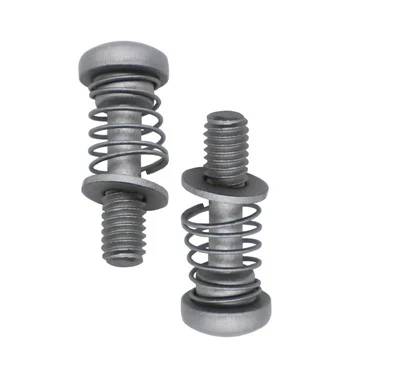
In fastener industry terminology, SEMS screws are defined as combination screws with pre-assembled captive washers. It is important to emphasize that SEMS does not refer to a specific material or strength grade, but rather describes a structural configuration.
From an engineering standpoint, a SEMS screw assembly consists of two main components:
Screw body – provides axial clamping force and structural fastening strength
Washer assembly – distributes load, increases contact area, or provides anti-loosening functionality
During manufacturing, the washer is pressed onto the screw shank using specialized automatic assembly equipment. A retention feature is formed at the major diameter of the thread. This design is known as a captive washer structure.
The engineering principle behind this structure allows the washer to rotate freely on the shank while preventing it from passing over the thread diameter and separating from the screw. As a result, the washer remains permanently attached during transportation, vibration, and automated feeding processes.
2. Structural Components and Engineering Design Principles
2.1 Screw Body Design Logic
The screw body used in SEMS fasteners is not limited to a single type and can be designed according to application requirements. Common options include:
Machine screws
Self-tapping screws
Thread-forming screws
Flange screws
Various head styles (pan head, countersunk head, hex head), drive types (Phillips, hex socket, Torx), and thread standards (metric or imperial) can be combined with washer assemblies to form customized SEMS solutions.
From an engineering perspective, the screw diameter, tolerance control, and material strength grade directly affect fastening performance. These parameters must be precisely matched with the washer's inner diameter and thickness; otherwise, the captive function or assembly smoothness may be compromised.
2.2 Functional Design of Washer Assemblies
The washer component in a SEMS screw serves multiple functions, depending on the application environment:
Flat washers distribute load and protect the contact surface
Spring washers provide continuous preload through elastic deformation and are suitable for vibration environments
Lock washers enhance resistance to loosening
Conical washers are used in high-load or high-stress concentration applications
The washer's inner diameter must be slightly smaller than the screw's major thread diameter to enable press-fit retention. Washer thickness and hardness also influence post-assembly rotation smoothness and wear resistance. Therefore, material compatibility and functional requirements must be considered holistically when defining SEMS screw specifications.
2.3 Materials and Surface Treatments
Common SEMS screw materials include carbon steel, stainless steel, and alloy steel:
Carbon steel is cost-effective and suitable for general industrial environments
Stainless steel is ideal for high-humidity or corrosive conditions
Alloy steel is used in high-strength applications
Surface treatments such as zinc plating, nickel plating, Dacromet coating, and black oxide finishing affect not only appearance but also corrosion resistance and salt spray performance.
3. Manufacturing Process of SEMS Screws
When selecting a SEMS screw manufacturer, understanding the production process is critical. The typical manufacturing flow includes the following steps:
Cold heading – High-precision cold heading machines form the screw head and shank in a single operation, improving material density and mechanical strength.
Thread rolling – Threads are formed using rolling technology, which enhances tensile strength and surface finish.
Washer stamping and inspection – Washers are produced via stamping, followed by dimensional sorting and hardness testing to ensure compatibility.
Automatic assembly – Washers are press-fitted onto the screw shank using automated SEMS assembly equipment.
Surface treatment and testing – Finished products undergo surface treatment, salt spray testing, torque testing, tensile testing, and dimensional inspection to meet customer specifications.
4. Why Use SEMS Screws?
When evaluating the benefits of SEMS screws, companies should consider overall manufacturing efficiency rather than focusing solely on unit cost.
First, SEMS screws significantly improve assembly efficiency. Since washers are pre-installed, operators do not need to handle separate components, reducing assembly steps and cycle time. In automated production lines, SEMS screws are easier to feed through vibratory bowl systems, resulting in more consistent takt times.
Second, SEMS designs effectively eliminate missing-washer risks. In electronic products, missing washers can cause poor grounding or localized stress concentration. Captive washer structures completely eliminate this issue.
Third, from a total cost perspective, although SEMS screws are more expensive per piece than standard screws, they reduce labor costs, rework rates, and quality variation-often resulting in lower overall manufacturing costs.
5. Industry Applications of SEMS Screws
Electronics Industry
SEMS screws are widely used for PCB mounting, power module fastening, and enclosure grounding. Because electronic products require high assembly precision and stable electrical contact, SEMS screws with washers provide more uniform clamping force and improved connection reliability.
Automotive Manufacturing
In the automotive sector, SEMS screws are commonly applied in onboard electronic systems, instrument panels, and control modules. Given strict requirements for vibration resistance and corrosion protection, SEMS screws with spring washers enhance long-term reliability.
Home Appliances and Industrial Equipment
In appliances and industrial devices-such as washing machines, induction cookers, and control panels-SEMS screws are ideal for high-volume, high-speed assembly environments. Their pre-assembled design reduces manual handling and significantly improves production line efficiency.
6. Customization and Selection Logic for SEMS Screws
As OEM projects become more complex, demand for custom SEMS screws continues to grow. When selecting an OEM SEMS screw supplier, the following factors should be evaluated:
Capability for non-standard design and development
Availability of automated SEMS assembly equipment
Material certification and testing documentation
Long-term stable supply capacity
A reliable SEMS screw factory typically provides one-stop services ranging from drawing evaluation and sample testing to mass production, supported by a strict quality control system to ensure product consistency.
Conclusion
SEMS screws are not simply screws with washers. They are engineered combination fasteners designed to improve assembly efficiency, reduce manufacturing risk, and enhance long-term reliability through structural optimization-making them a strategic fastening solution in modern manufacturing environments.