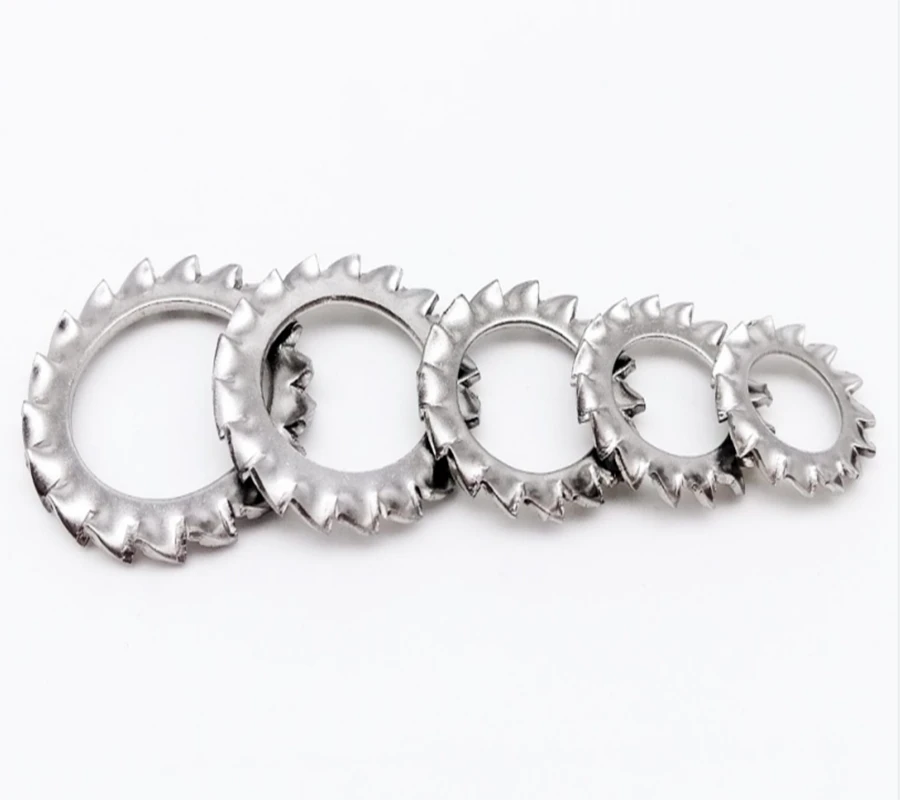
In mechanical assembly, washers are often regarded as inconspicuous small parts, and many people think that their function is only to "prevent nuts from loosening." However, the function of washers is far more than that! Different types of washers play a key role in the connection structure. Choosing the wrong washers may lead to connection failure, part damage, and even safety accidents. This article will deeply analyze the true purpose of common washers, such as flat washers and spring washers, to help engineers and purchasers choose washers correctly.
A. The four core functions of washers
1. Disperse pressure and protect the connection surface
Problem: When bolts/nuts are directly pressed on soft materials (such as aluminum and plastic), the surface may be crushed or deformed.
Solution: Plain washers increase the force area, evenly distribute pressure, and avoid damage to the substrate.
Typical applications: aluminum alloy shell fixation, wooden structure connection.
2. Anti-loosening and anti-vibration, maintain preload
Problem: Under a vibration environment, ordinary bolts and nuts are prone to loosening due to micro-motion wear.
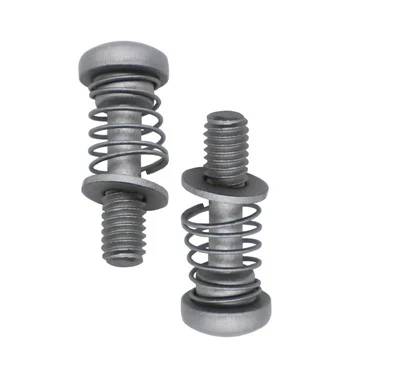
Solution: Spring washers use elastic deformation to generate a continuous rebound force to offset the relaxation caused by vibration.
Typical applications: automobile chassis, motor installation, rail transit.
3. Sealing and leakproof, isolating media
Problem: Liquid or gas may leak through the thread gap.
Solution: Sealing washers, such as copper washers and rubber washers, fill microscopic uneven surfaces to block leakage paths.
Typical applications: pipeline flanges, hydraulic systems, engine oil circuits.
4. Insulation/conductivity, adapting to special needs
Problem: Current may form a short circuit through metal bolts, or static electricity needs to be conducted away.
Solution: Insulating washers (such as nylon, red steel paper): used for electronic equipment and transformers.
Conductive washers (such as copper-plated spring washers): used for anti-static grounding.
B. Common types of washers and applicable scenarios
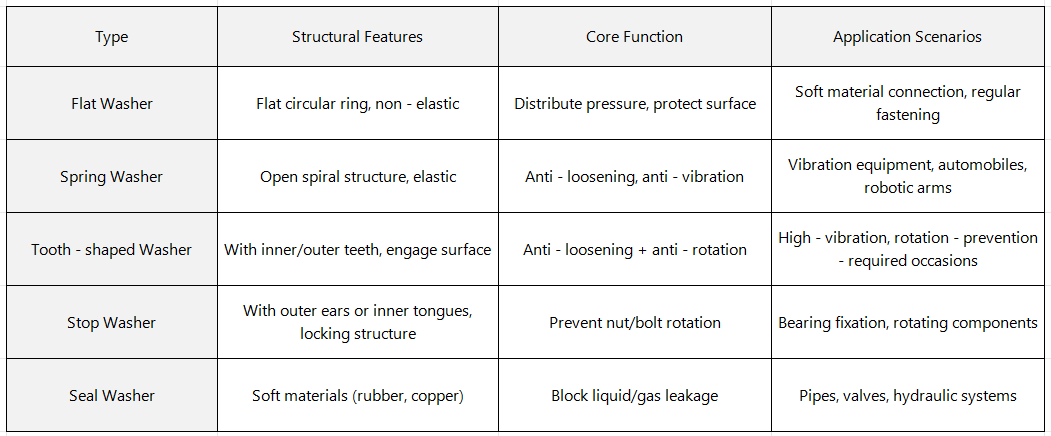
Although the washers are small, they are indispensable "multi-functional guards" in mechanical connections. Correctly selecting the type and material of washers can significantly improve the reliability, sealing, and life of the connection. Next time you design or repair, you might as well spend an extra minute to check whether the washers match your needs!