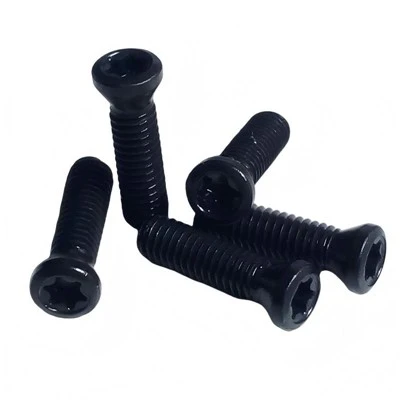
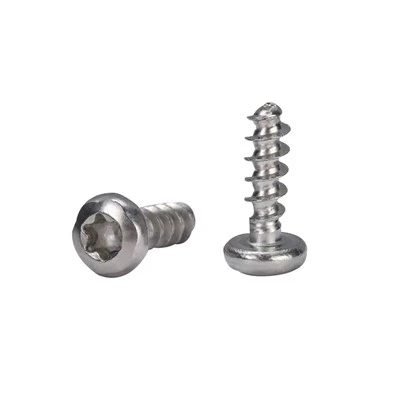
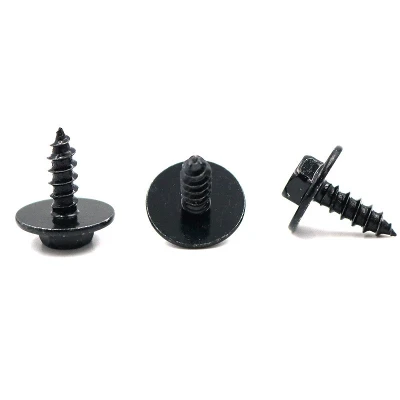
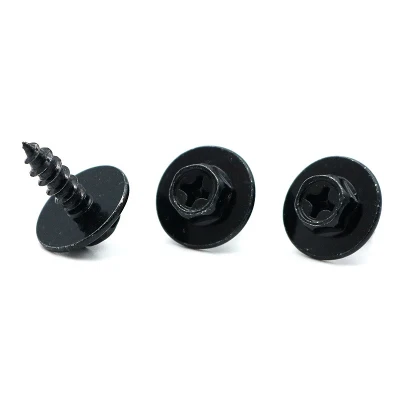
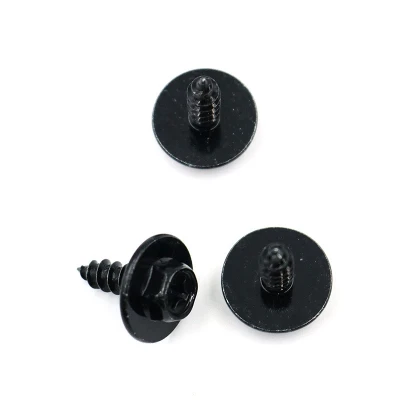
This non-standard, cold-forged carbon steel zinc-nickel alloy hexagonal self-tapping screw, featuring a black, enlarged washer, is a high-performance fastener. This detailed technical description of the surface treatment is organized by key points, balancing professionalism and practicality.
1. Substrate Pretreatment
Degreasing: Remove grease from the cold-forged surface using an alkaline solution (pH 10-12) at 60-80°C for 5-10 minutes.
Acid Cleaning: Use hydrochloric acid or sulfuric acid for 1-3 minutes to avoid excessive corrosion.
Phosphating: A zinc phosphate coating (film weight 1.5-3.0 g/m²) improves the adhesion of subsequent coatings and is suitable for high-load applications.
2. Zinc-Nickel Alloy Electroplating Core Process
Bath formula: Zn²⁺ 8-12 g/L, Ni²⁺ 1-2 g/L (Zn-Ni ratio 12-15:1)
Alkaline system (pH 13-14), additives include a complexing agent (such as EDTA) and a brightener
Process parameters: Current density 2-4 A/dm², temperature 20-30°C, plating time 15-25 minutes. Cathode movement (frequency 15-20 times/minute) ensures uniformity.
Post-treatment: Three-stage countercurrent rinse → Passivation (trivalent chromium passivation, Cr³⁺ 0.5-1.0 g/L, pH 4.5-5.5) → Sealing (silane system)
3. Black Surface Treatment Options
Blackening Process Options
Black passivation: Post-plating chromate conversion coating. Low cost but average wear resistance (salt spray 48 hours).
Organic Coating: Epoxy resin electrostatic spray coating, thickness 20-30μm, salt spray 500 hours or more.
Oxidation Blackening: Alkaline high-temperature oxidation, decorative only, no rust protection.
4. Key Performance Verification
Adhesion Test: Cross-cut test reaches Level 0, bend test (90°) shows no peeling.
Corrosion Resistance: Neutral salt spray test for >1000 hours, no red rust (zinc-nickel alloy + sealant).
Friction Coefficient Control: Coated screws must maintain a coefficient of friction between 0.10 and 0.15.
6. Production Precautions
Hydrogen Embrittlement Risk: Dehydrogenation treatment at 200°C for 2 hours must be performed within 4 hours after electroplating (required for hardness >32 HRC).
Color Consistency: The black passivation bath solution must be regularly analyzed for Ni²⁺ content (control it to <5ppm to prevent flaking).
This process chain design achieves high corrosion resistance (zinc-nickel alloy), decorative properties (matte black), and functionality (self-tapping and integrated washer), making it suitable for demanding environments such as automotive and photovoltaic mounting systems. In actual production, it is recommended to conduct a small batch test to verify the coating adhesion and thread fit accuracy.