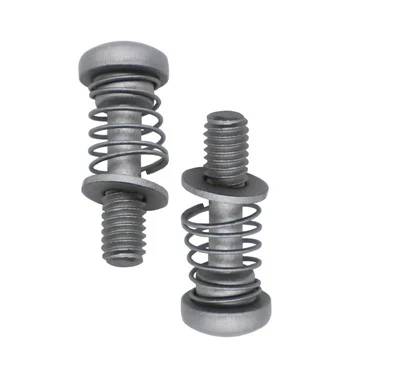
The surface treatment for colored aluminum alloy 6061 hexagon socket head screws (umbrella head screws/bolts) requires a balance of aesthetics, corrosion resistance, and mechanical performance. Detailed treatment recommendations for different specifications are provided below.
1. Anodizing
Process Features: Electrolysis creates a dense oxide film (Al₂O₃) on the surface, resulting in high hardness and excellent wear resistance. Customizable colors are available to meet color requirements.
The oxide film thickness is typically 5-25μm. A thin layer (5-10μm) is recommended for sizes M2.5-M3, while a thicker layer (10-20μm) can be applied for sizes M4-M8.
Advantages: Maintains the lightweight properties of aluminum alloy 6061 without compromising thread accuracy; salt spray resistance can reach 500-1000 hours (depending on film thickness and sealing process).
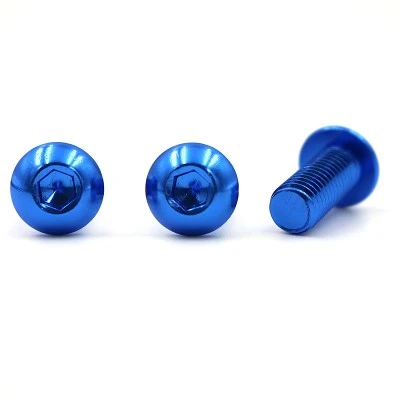
Notes: For hard anodizing, the film thickness can reach 30μm, but brittleness must be controlled. Sealing treatment is required after dyeing to enhance color fastness.
2. Electrophoretic Coating
Applicable Applications: Requires extremely high color uniformity (such as light colors or special hues). Suitable for sizes M4-M8; uneven coating coverage is more likely with smaller sizes.
Process Parameters: Coating thickness 10-20μm, salt spray resistance 300-500 hours.
Matte/gloss finishes are available, but wear resistance is slightly inferior to anodizing.

3. Micro-arc Oxidation (High Strength Requirements)
Applicability: For high-load bolts M6-M8, this surface is ceramicized, achieving a hardness of HV1500 or higher.
Colors are limited (off-white/dark gray), but corrosion resistance is excellent (salt spray resistance 1000+ hours).
Cost Considerations: This process is relatively costly and is suitable for military or marine applications.
Critical Quality Control Points: Thread protection: Specialized tooling is required to protect the threads before oxidation to prevent dimensional variation.
Hydrogen Embrittlement Risk: High-strength bolts must be dehydrogenated and baked within 24 hours after oxidation.
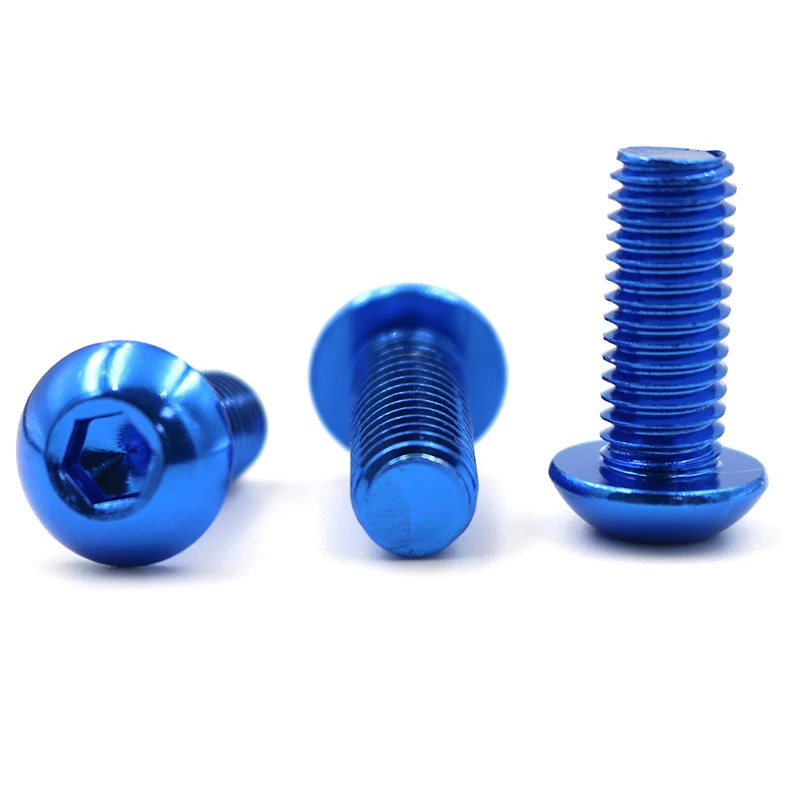
Salt spray testing: According to ASTM B117, color anodizing must remain rust-free for 720 hours.
Environmental and cost comparison
Anodizing: The most cost-effective, environmentally friendly, and suitable for mass production.
Micro-arc oxidation: Highly expensive but with a long lifespan, suitable for specialized applications.
Electrophoresis/spray coating: Suitable for small-batch, multi-color production, but less environmentally friendly.
We recommend choosing a suitable method based on the application (decorative/industrial/outdoor) and budget, prioritizing sample verification.