The hexagonal flange half-thread bolt is a specific type of high-strength, multi-purpose fastener. It is also a commonly used fastener in mechanical connections. Its structural characteristics and functional design make it advantageous in specific scenarios. The following is a detailed analysis of the aspects of similarities and differences.
1. Similarities
The basic structure is the same: both include a hexagonal head, flange surface, and screw.
The flange surface design can increase the contact area, disperse the pressure, replace a single gasket, and have better anti-loosening performance than ordinary bolts.
Materials and strength grades
Common materials are carbon steel, stainless steel, or alloy steel, and the surface treatment is mostly galvanized, Dacromet, and other anti-corrosion processes. High-strength versions require quenching and tempering heat treatment.
Application scenarios: Suitable for occasions that require anti-loosening and anti-vibration, such as automobile chassis, construction machinery, steel structure connections, etc.
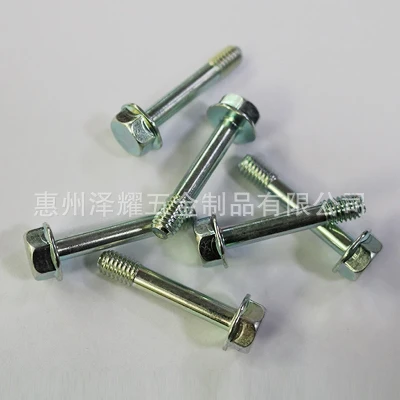
The flange surface design is particularly suitable for soft materials or thin plate connections to avoid crushing.
2. Differences
Thread length
Short half-thread type: The non-threaded section is longer, suitable for connections that require high shear strength.
Long half-tooth type: The thread segment accounts for a large proportion, which is suitable for thick workpieces or scenes requiring deep meshing.
Flange surface design
Flat flange: The flange surface is flat, with strong versatility and low cost.
Serrated flange: The flange has internal/external serrations, which has better anti-loosening performance.
Size and standard

Standard difference: For example, the national standard, German standard, and American standard have slight differences in flange diameter, thickness, or thread tolerance.
Non-standard customization: Special flange tooth shapes, thickened flanges, or special-shaped hexagonal heads require separate processing.
3. Selection suggestion
Give priority to the half-tooth ratio: choose a long light rod type for frequent vibration and a long thread type for thick workpieces.
Flange tooth shape selection: A serrated flange is used in high-vibration environments, but it may damage a soft substrate.
Standard matching: Export equipment must meet the standards of the target market
Through the above comparison, differentiated bolt models can be accurately selected under similar frameworks according to specific working conditions to balance cost and performance.