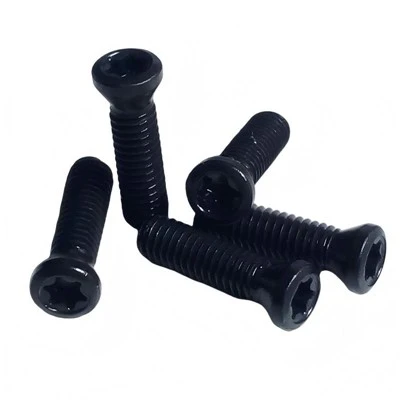
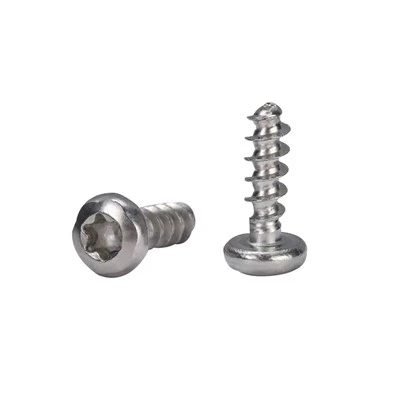
M1 M1.2 M1.4 M2 M3 Brass cylindrical head slotted screws are small mechanical fasteners that belong to the category of precision screws. The following is a detailed comparative analysis of it, covering similarities and differences, and the content is presented in logical layers.
I. Similarities
Material characteristics
Both are made of brass, which has good corrosion resistance, conductivity, and ductility, and is suitable for rust-proof scenes such as electronics and decoration.
Head design
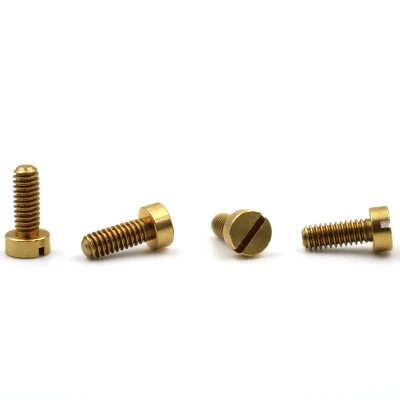
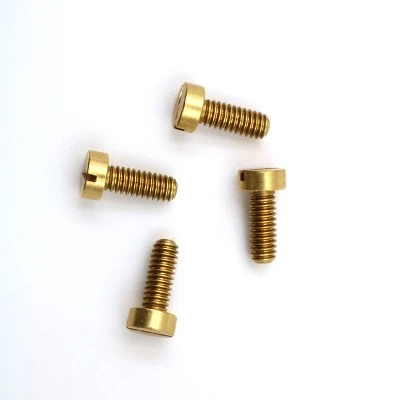
Cylindrical head: The head diameter is uniformly larger than the thread diameter, providing a flat installation surface.
Slotted: Compatible with standard slotted screwdrivers, simplifying the need for installation tools.
Surface treatment: Common nickel plating, chrome plating, or natural polishing, taking into account both beauty and oxidation resistance.
Standardized production: by ISO or GB standards, the thread is a metric standard.
II. Differences
Key differences:
The thread diameter directly affects the load-bearing capacity, and the tensile strength of M3 is significantly higher than that of M1.
The pitch increases with the increase of diameter, affecting the fastening accuracy, and fine teeth are more anti-loosening.
Mechanical properties
Tensile strength: M1 is about 200-300N, M3 can reach 800-1000N (brass has lower strength and is only suitable for light loads).
Torque requirements: M1 requires 0.05-0.1N·m, M3 requires 0.3-0.5N·m, and the screwdriver size must be matched to avoid slipping.
Application scenarios
M1-M1.4: precision electronics (such as PCB fixing), eyeglass frames, and micro-instruments.
M2-M3: home appliance housings, lamp assembly, and medium-load structural parts (such as door hinges).
Processing and cost
Microscrews require high processing precision, strict tolerances, and relatively high costs.
Larger sizes (M2-M3): low production difficulty and obvious batch cost advantages.
3. Selection recommendations
Prioritize load: choose la large diameter in a vibration environment, and M1.2 for static light load.
Space restrictions: M1 is required for compact spaces to avoid head interference.
Tool matching: It is recommended to use anti-static precision screwdrivers below M1.4 to prevent damage to the notch.
Summary
The commonality of brass slotted screws lies in the material and basic design, while the differences are concentrated in the mechanical properties and application scenarios derived from the size. When selecting, it is necessary to balance the three factors of load, space, and cost. Microscrews focus more on precision, and conventional sizes focus on cost-effectiveness.
This solution takes into account both technical details and procurement decision-making efficiency, and can further simplify or expand specific modules according to actual needs.