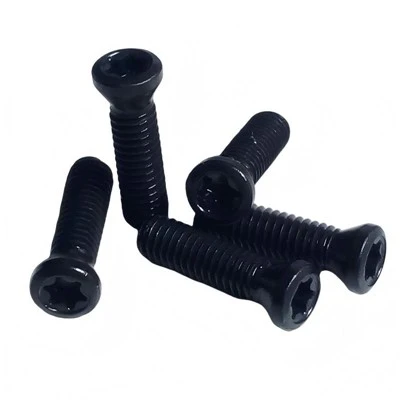
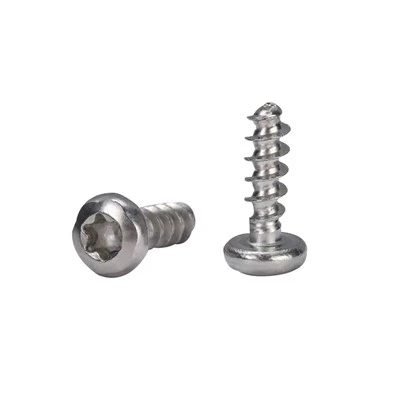
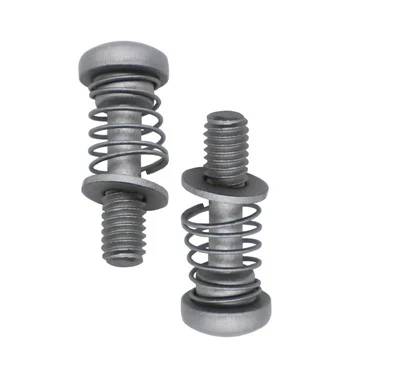
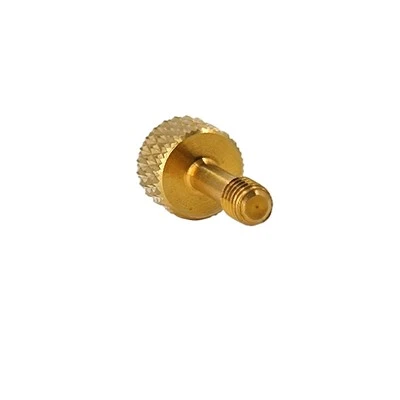
The following is a detailed guide to using stainless steel 304 cross flat head slotted pins/pins/circlip locating studs (cylindrical, sizes M3-M10), categorized by application scenario.
I. Product Overview
Material: A2 304 stainless steel, corrosion-resistant, suitable for humid, acidic, and alkaline environments.
Features
Cross head: Can be installed with a Phillips screwdriver, with a non-slip design.
Slotted: The slot is used to install a circlip, preventing axial displacement.
Plain rod cylindrical: Precision-fits the hole for positioning or connection.
Common sizes: M3, M4, M5, M6, M8, M10 (diameter x length optional).

II. Core Applications
Location pins: Used for aligning mechanical components (such as molds and gearboxes), securing them in place through an interference fit.
Example: Press an M6 pin into a base hole and then attach a cover plate to ensure concentricity.
Shaft fixing: Used as a rotating shaft, with a circlip at the end to prevent fallout.
Structural Connection: Nuts replace bolts, suitable for applications requiring frequent disassembly.
III. Installation Steps
1. Basic Installation (No Circlip)
Tools: Phillips screwdriver, rubber mallet.
Process:
a. Clean the hole to ensure it is free of burrs.
b. Align the hole and manually screw the pin in until it is fully seated in the cross slot.
c. Tighten with a screwdriver (reference torque: M3 ≈ 0.5 N·m, M8 ≈ 10 N·m).

2. Circlip Installation (Anti-slip Design)
Tools: Circlip pliers, calipers.
Key Steps:
a. Measure the diameter of the pin slot and match the corresponding circlip (e.g., M5 pin with 5mm circlip).
b. Insert the pin into the hole and use circlip pliers to pry the circlip into the slot.
c. Check that the circlip is fully seated in the slot to prevent loosening.
3. Interference Fit Installation
Application: High-precision positioning (e.g., bearing seat).
Method:
Machine the hole diameter to 0.01-0.03mm smaller than the pin.
Assemble using a press or freezing method (shrinking the pin) to avoid deformation caused by impact.
IV. Precautions
Selection Recommendation: 316 stainless steel is preferred for humid environments; dynamic loads require shear strength verification.
Installation Taboos: Do not over-torque, as this may cause the cross recess to strip.
The circlip opening should avoid the movement path to prevent accidental snagging.
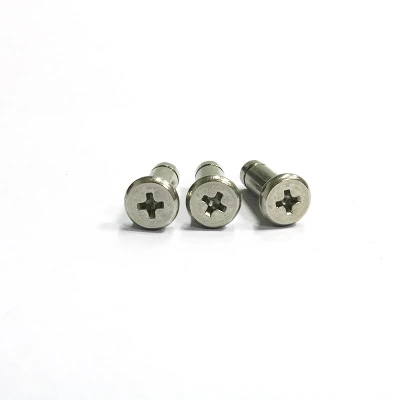
Maintenance: Regularly check the circlip elasticity and lubricate with WD-40 if rust occurs.
V. Common Problem Solutions
Problem 1: Loose pin.
Solution: Use an anaerobic adhesive or replace the pin with a larger size (e.g., M4 to M5).
Problem 2: Circlip detached.
Solution: Check the notch for wear and replace it with a thicker circlip.
VI. Application Example
M3/M4: Positioning circuit boards for precision instruments.
M6/M8: Agricultural machinery hinges and conveyor belt roller mounting.
M10: Heavy equipment bracket connections, with double retaining springs for vibration protection.
Through proper selection and proper installation, this type of pin provides a highly reliable mechanical connection and positioning.