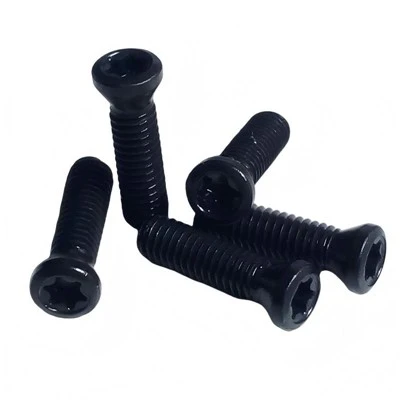
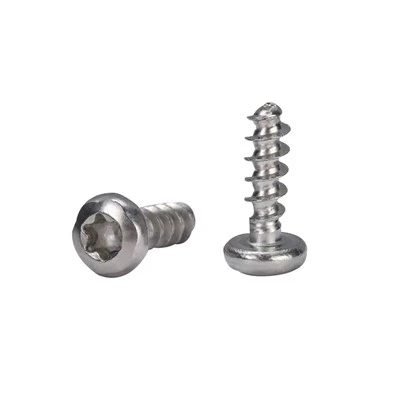
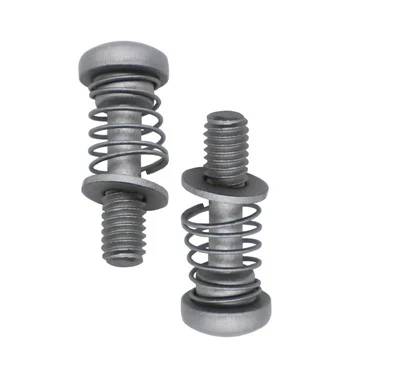
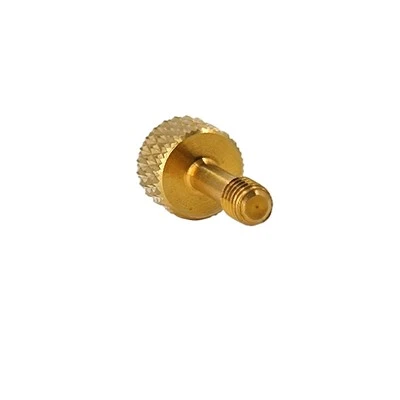
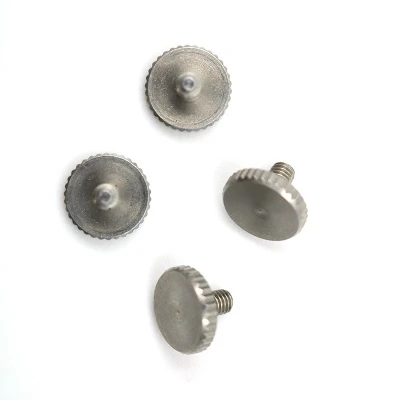
303 stainless steel American thread automatic lathe straight knurled hand screw is a specific type of manual fastener. The following is a guide to its use.
1. Product Overview
303 stainless steel American thread straight knurled hand screw is precisely processed by an automatic lathe and has the following characteristics.
Material: 303 stainless steel, with easy cutting, corrosion resistance, and medium strength.
Thread standard: American unified thread.
Knurl type: The anti-slip design of straight knurling is adopted, which is convenient for manual tightening.
Processing technology: automatic lathe forming, high dimensional accuracy.
Typical applications: instrument panels, electronic equipment, furniture hardware, medical equipment, and other scenes that require frequent manual adjustment.
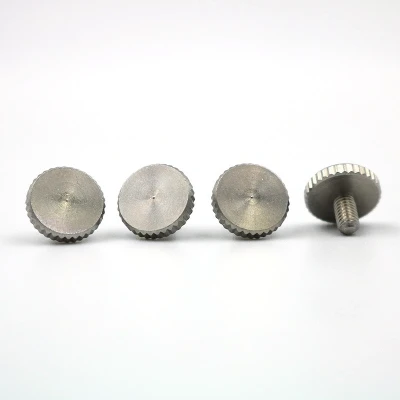
2. Usage steps and precautions
Before installation, check and verify whether the thread specifications match the mating parts. Check whether the knurling of the screw head is complete and free of burrs.
Manual tightening operation: Align the thread and insert it vertically into the screw hole. When initially screwing it in, turn it counterclockwise until you feel a "click" sound to ensure that the thread is properly engaged.
Tightening force: pinch the knurled part with your thumb and index finger and rotate it; no tools are needed; if the resistance is too large, check whether the thread is damaged or there is foreign matter.
Anti-loosening treatment (optional): When anti-loosening is required, you can use a nylon washer or apply a small amount of thread glue to avoid over-tightening and causing the 303 stainless steel thread to slip.
Maintenance and disassembly: Clean the threaded part regularly to prevent dust accumulation from affecting the meshing; when disassembling, rotate the knurled head counterclockwise. If it is rusted, spray WD-40 to lubricate it before operation.
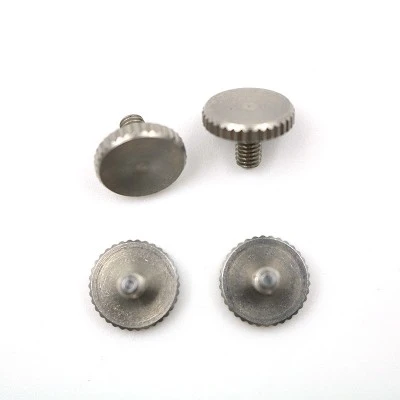
3. Common problems and solutions
Problem 1: Difficulty in screwing in the screw
Cause: The thread is not aligned, or there is debris in the hole.
Solution: Clean the screw hole and realign the starting teeth.
Problem 2: Knurling slips
Cause: The knurling pattern is worn, or the hands are oily.
Solution: Replace the screw or wear non-slip gloves to operate.
Problem 3: Thread rust
Cause: 303 stainless steel may rust in a chloride ion environment.
Solution: Use 316 stainless steel or apply anti-rust oil regularly.
4. Selection Recommendations
High-load scenarios: It is recommended to choose 304 or 316 stainless steel materials, which need to be customized.
Non-standard requirements: The knurling spacing or head diameter can be adjusted, and drawings need to be provided.
Tip: It is recommended to provide a sample trial installation when purchasing in batches to ensure compatibility. A complete 2D drawing or 3D STEP file is required, and key dimensions need to be marked separately. Special requirements require additional negotiation of tooling costs.
Through the design and process control described above, it can be seen that the screw strikes a balance between functionality, production efficiency, and reliability, and is suitable for medium and high-intensity use requirements.