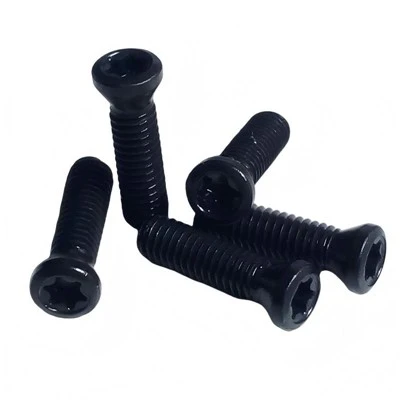
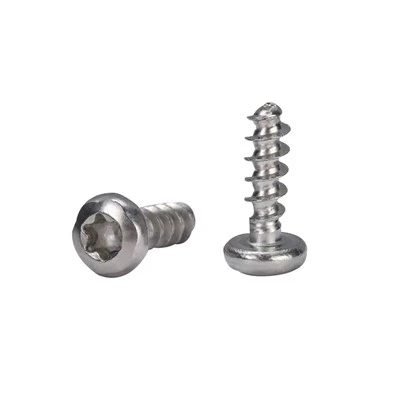
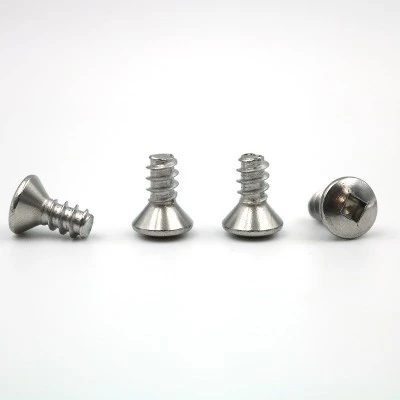
M2.5 M3 M4 M5 Stainless steel 304/316 countersunk square hole self-tapping screw is a specific type of screw. The following is a detailed description of its customization requirements. The content structure is clear, taking into account both technical points and practicality.
1. Basic parameter requirements
Specification model:
Nominal diameter: M2.5, M3, M4, M5.
Length range: 6mm~50mm.
Head type and drive mode:
Countersunk Head: Head angle 90 ° ± 2 °, ensuring flush contact with the substrate surface.
Square Recess: Complies with ISO 10664 standard.
Recommended size
M2.5: H1.5 square hole
M3: H2.0 square hole
M4/M5: H2.5 square hole
2. Material and surface treatment
Material options:
Stainless steel 304: General type, good corrosion resistance, suitable for most environments.
Stainless steel 316: Higher corrosion resistance (chloride and acid environment resistance), recommended for marine or chemical environments.
Surface treatment: Default passivation treatment improves rust resistance, optional nickel plating or Dacromet to enhance wear resistance.
3. Thread and tapping characteristics
Self-tapping thread: suitable for metal or hard plastic. Recommended thread length ≥ 2 times the diameter.
Guide design: sharp guide end or with cutting groove to ensure fast cutting into the material.

4. Performance and test standards
Mechanical properties: 304/316 stainless steel hardness: HV200~300.
Minimum breaking torque (reference):
M3: ≥2.5 N·m
M5: ≥8.0 N·m
Salt spray test:
Stainless steel 304: ≥96 hours neutral salt spray.
Stainless steel 316: ≥168 hours.
5. Customized additional options
Non-standard requirements:
Extended thread, full thread, or anti-loosening nylon washer can be customized, with special marking.
Packing standard: 1000pcs/box, or packaged according to customer requirements.

7. Notes
Material certification: Material report is required.
Sample confirmation: It is recommended to provide 3~5pcs samples to verify the size and adaptability.
Delivery time: Mass production cycle is 7~15 days, depending on quantity and process complexity.
The above content can be further refined according to the actual application scenario. It is recommended to provide drawings or samples to ensure accurate matching requirements.