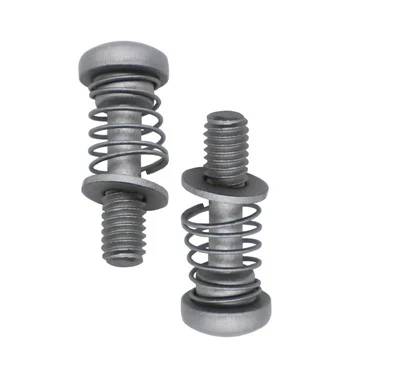
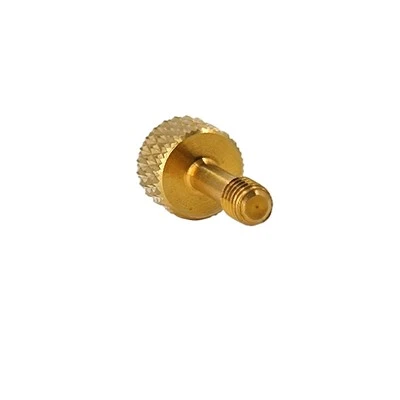
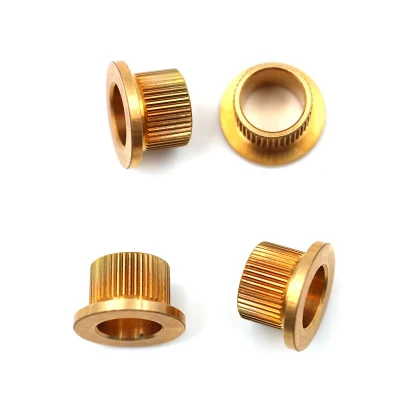
Brass knurled stepped flange rivets are specially designed rivets that combine multiple structural and functional features. They are primarily used in applications requiring fastening, anti-slip properties, or aesthetics. Their core functions and features can be systematically summarized as follows.
1. Efficient Fastening and Anti-Loosening
Knurling Design: Diamond-shaped or straight knurling on the rivet shank increases the coefficient of friction. Once inserted into the mounting hole, it creates a mechanical lock, effectively resisting loosening under vibration or dynamic loads. They are suitable for high-vibration environments such as motors and instruments.
Step Structure: Stepped diameter variations provide multi-level fixation, ensuring precise axial positioning of components and preventing lateral displacement.

2. Quick Installation and Permanent Fixing
Riveting Process: Deformation is achieved through cold or hot riveting, and the tail expands to create a permanent lock. No auxiliary nut is required, making it suitable for confined spaces or single-sided operation.
Flange Support Surface: The widened flange plate distributes contact pressure, preventing deformation of thin sheet materials while improving sealing.
3. Optimized Material Properties
Advantages of Brass:
Corrosion Resistance: Naturally resistant to moisture and weakly acidic environments, suitable for marine and outdoor equipment.
Electrical/Thermal Conductivity: Suitable for structures requiring current conduction or heat dissipation.
Ductility: High plastic deformation during riveting ensures tight filling of irregularly shaped holes.
4. Versatile Application Compatibility
Decorative Needs: Brass surfaces can be polished, nickel-plated, or distressed, complementing industrial aesthetics (e.g., furniture and vintage lamps).
Dimensional Flexibility: Customizable step height and flange diameter accommodate stacked assembly of panels of varying thicknesses (e.g., laminating PCBs to metal brackets).
Typical Applications:
Electronic and electrical: PCB brackets, heat sink mounting.
Automotive: Interior components, sensor mounting.
Architectural Decoration: Metal curtain wall connections, handrail riveted joints.
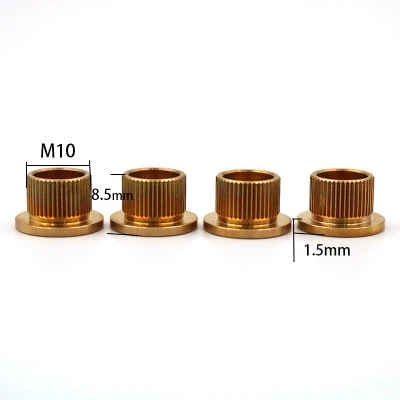
Key Selection Parameters:
Knurl Type: Choose between straight (unidirectional load) or crosshatch (multi-directional load) based on torsional resistance requirements.
Step Tolerance: This must match the cumulative thickness of the plate, typically allowing for a compression allowance of 0.1-0.3mm.
Flange Thickness: For high shear stress scenarios, the flange thickness should be increased (e.g., ≥1.5mm).
Through this design combination, this rivet provides a reliable mechanical connection while balancing installation efficiency and environmental adaptability, making it a highly functional solution for brass fasteners.