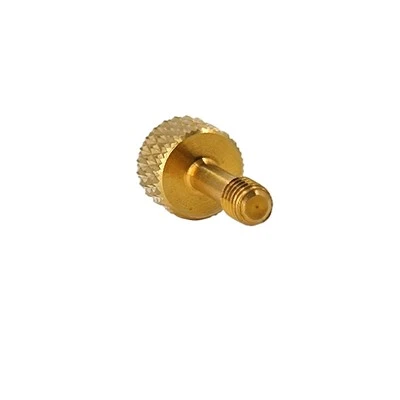
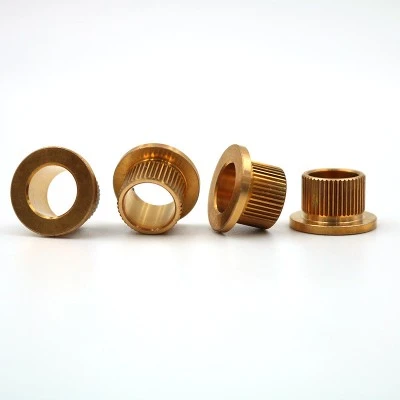
A brass knurled step flange rivet is a specially designed rivet that combines multiple structural and functional characteristics. Its core functions and features can be systematically summarized as follows.
1. Core parameter customization requirements
Material specifications
Material: H62 or H65 brass, lead brass C3604 can also be selected to improve cutting performance
Hardness: HRB 55-75, heat treatment status needs to be marked
Tensile strength: ≥300MPa, military grade requires ≥400MPa
Structural dimensions
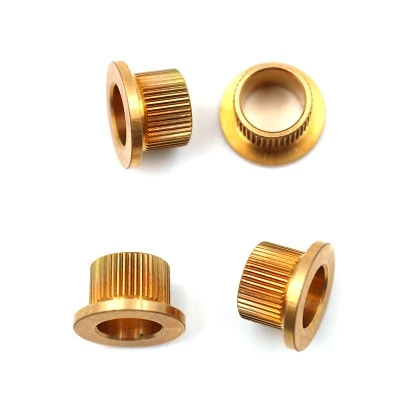
Step design: head diameter D=1.5-2.0×rod diameter d, step height h=0.3-0.5d
Knurling type: mesh knurling, tooth pitch 0.6-1.2mm
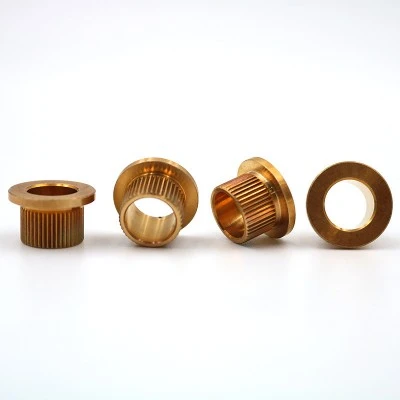
Flange edge: 45° chamfer or R0.2 fillet (anti-burr)
Surface treatment
Plating: optional nickel, tin, or passivation treatment
Special requirements: Chemical nickel plating is suitable for high corrosion resistance scenarios
II. Key points of process control
Cold heading forming die life ≥500,000 times, coaxiality: ≤0.05mm
Knurling processing: radial pressure: 3-5kN, double-wheel knurling machine
Testing standards
Key items: head circle runout ≤0.1mm, knurling tooth profile integrity ≥90%
Sampling plan: GB/T2828.1 II level AQL1.0
III. Application adaptation suggestions
Working condition matching
Vibration environment: It is recommended to add serrations on the back of the flange
Conductive requirements: Prioritize non-plating passivation treatment
Installation guidance
Calculation of riveting force: F=0.6×σb×As (σb is material strength, As is cross-sectional area)
Board hole tolerance: H11 level matching is recommended
IV. Customized service process
Technical docking
Required to provide:
Assembly cross-section diagram (marking the material and thickness of adjacent parts)
Environmental testing report (such as salt spray test requirements)
Quotation Cycle
Provide a solution within 3 days (less than 1,000 pieces)
Mold fee: ¥800-2,000 (can be included in the unit price)
Delivery guarantee
Full-size report of the first piece, including 3D scanning data)
Batch warranty (including material spectrum analysis)
V. Common failure avoidance
Knurling and sliding: increase the pitch to more than 1.0mm
Flange cracking: control the cold heading deformation ≤65%
Galvanic corrosion: avoid direct contact with aluminum alloy
This solution takes into account both manufacturing feasibility and application reliability, and the parameter weights can be adjusted according to specific working conditions. It is recommended to provide a sample test installation to verify the adaptability.
This design achieves a balance between functionality, reliability, and process cost through the coordinated optimization of materials and structures, and is suitable for the precision assembly needs of small and medium-sized equipment.