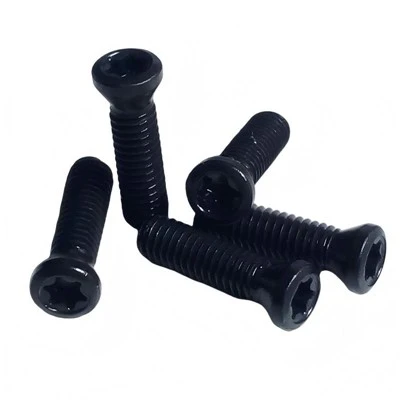
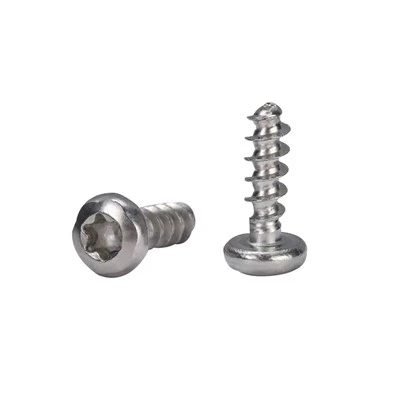
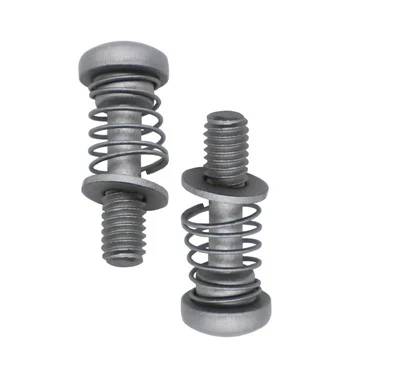
Self-tapping screws are a type of screw with a drill point that allows for drilling, tapping, fastening, and locking to be completed in a single step using a power tool. They are mainly used for connecting and securing thin sheet materials, such as color steel plates to each other, or to purlins and wall beams. Their typical penetration capacity is up to 6mm, with a maximum of 12mm.
Self-tapping screws are often exposed outdoors and feature strong corrosion resistance. A rubber sealing washer ensures waterproof performance and further enhances corrosion resistance. These screws are usually described using three parameters: screw diameter size, threads per inch (TPI), and screw length. Common diameter sizes are #10 (4.87mm) and #12 (5.43mm); thread pitches include 14, 16, and 24 TPI. The higher the TPI, the stronger the self-drilling capability.
Product Differences
Self-tapping screws are hard, with wide and deep threads and a rough surface, whereas wood screws are softer, have finer threads, and often lack threading near the tail end. Wood screws also have duller and softer points. In contrast, self-tapping screws have coarser, sharper, and harder threads.
Types of Self-Tapping Screws
Thread Forming Tapping Screws
Derived from sheet metal screws, these screws require a pre-drilled hole. When inserted, the screw deforms the material to create a matching internal thread by displacing the surrounding material. These are suitable for thin and ductile materials.
Thread Cutting Tapping Screws
Feature one or more cutting flutes at the end of the thread, allowing them to cut matching internal threads into pre-drilled holes, similar to a tap. These are ideal for thick, hard, or brittle materials.
Thread Rolling Tapping Screws
Also known as Type TT (still under patent protection), these have a special thread and tail design to roll threads under intermittent pressure. This design ensures better material flow into thread spaces, lower friction compared to thread-forming types, more controlled torque, and higher assembly strength. They are better suited for structural applications, with stricter standards for material, heat treatment, and strength.
Self-Drilling Tapping Screws (Drill Point Screws / Tec Screws)
These eliminate the need for pre-drilling, combining drilling, tapping, and fastening in one step, saving labor and cost. Their surface and core hardness are higher due to the added drilling function. They must pass penetration tests to ensure they can drill and tap within a specified time.
Special Designs
High-Low Thread Tapping Screws
Designed for plastics or low-density materials, featuring a dual-thread design. The larger high thread has a 30° angle, while the smaller low thread has a 60° angle and half the height. This combination reduces driving torque and increases pull-out strength while lowering the risk of material cracking.
Twin Lead Self-Drilling Tapping Screws
Designed for drywall and construction applications. They easily drill into drywall and tap threads into metal studs. The bugle head with a concave bearing surface avoids damaging wallpaper or plaster when installed.
Most self-tapping screws are for commercial use. When offered as SEMS screws (pre-assembled with washers), they provide enhanced convenience. Some feature special thread designs to improve anti-loosening performance after assembly.
Structure of a Self-Tapping Screw
A self-tapping screw consists of three parts: head, shank, and tip. Each screw can be described by four key elements:
Head Shapes
Common types include round head, pan head, oval head, truss head, flat head, countersunk head, semi-countersunk, cylinder head, dome cylinder head, bugle head, hex head, hex flange head, and hex washer head.
Drive Types
External Drives: Hex, hex flange, hex washer, Torx, etc.
Internal Drives: Slotted, Phillips (H-type), Pozidriv (Z-type), Frearson (F-type), square (Scrulox), combo, internal spline, Torx, tri-wing, hex socket, 12-point socket, clutch, six-lobe, high torque cross, etc.
Thread Types
These include wide thread (self-tapping), machine thread, drywall thread, particle board thread, and other specialized threads. Threads may also be single lead, double lead, multiple lead, or high-low dual threads.
Tip Types
Common forms include saw end and flat end. Depending on the function, the tip may be modified with flutes, slots, cuts, or drill-like features. Even within the same category, variations exist for different standards.